Chef Jeanne Rankin’s Story of Memory, Coast, and Kitchen
Jeanne’s story begins with movement. It begins with the quiet, persistent pull of curiosity. You can trace it back to Winnipeg, where she grew up, and where, as she puts it with a laugh, “I think anybody who grows up in Winnipeg wants to get out.”
There is no bitterness in that statement. Only a sense that life was meant to be wider than one horizon.
From an early age, Jeanne wanted to travel. She worked as a server to fund her journeys, following older siblings who had already begun mapping their own routes through the world. For Jeanne it was a way to discover how people live inside landscapes, how culture becomes visible through daily rituals, and how food always sits at the centre of those rituals.
It was during those early years of travel that her life quietly turned towards cooking.
Travel, Love, and the Discovery of Food
Jeanne met her ex-husband while travelling through Europe. She soon taught him how to serve tables so they could continue funding their travels together.
“Working as a waiter and making good tips was a really good way for a 20-year-old to make money to go travelling,” she recalls.
Their travels eventually took them through Asia, and it was there that food began to shift from background necessity into emotional centre. It was in India, Jeanne remembers, that they had a revelation.
“People come back to restaurants for good food,” she says. “They don’t necessarily come back for good service, but they come back for good food. Right. Ah, we’ve got to get into the kitchen.”
From there, travel became culinary education. They traded books in Nepal, eventually finding a used copy of a New York Times cookbook by Katie Stewart. They read it in hostels and cafés, imagining themselves bringing the recipes to life for themselves and others.
“We thought, yeah, that sounds like a grand idea,” Jeanne says. “Let’s become cooks.”
Apprenticeship and Craft
Their first serious training came in London, where sincerity and hard work opened doors. They wrote letters to chefs whose work had captured global attention after earning Michelin stars.
To their surprise, they were given a chance.
Jeanne worked in the private function rooms of the restaurant while her husband began as a dishwasher. It was not glamorous work, but it was foundational. They learned discipline, precision, and respect for ingredients.
From there, they slowly worked their way into the kitchen itself. These early years shaped Jeanne’s culinary philosophy. She was less interested in food as spectacle and more interested in food as expression. Fine cuisine, she believed, did not need to feel heavy with technical display. Instead, she gravitated toward cooking that allowed ingredients to speak.
“I suppose what we liked was texture and colour and food with a bit of intrigue,” she says. “It should be zippy and play with your senses a bit. A little bit jump off the plate-y.”
She resisted the excesses of highly stylized plates. “Sometimes you get those temples of gastronomy where the food is almost tortured,” she says. “A good piece of duck doesn’t need to be manhandled that much.”
For Jeanne, cooking was always about respect. Respect for produce. Respect for geography. Respect for the animals, plants, and ecosystems that make cooking possible.
California, Ireland, and a Global Culinary Language
The couple’s career moved through multiple culinary landscapes. In California’s Napa Valley, Jeanne encountered the farm-to-table movement as it was emerging. The emphasis on local produce and wine pairing deeply influenced her cooking style. The food became lighter, more reflective of climate and soil than of European culinary hierarchy.
Later, they would move to Ireland, where they opened restaurants that blended global influences with local ingredients. Their work became known for combining classic French techniques with flavours and methods drawn from India, Asia, and other global cuisines they had encountered during travel. What mattered most was not strict authenticity, but emotional resonance.
In Belfast, they would create a Michelin-star restaurant of their own that reflected this very philosophy. The focus was always on letting ingredients remain recognizable, while at the same time still being elevated by technique.
With that recognition came a much bigger profile.
The BBC & Best Selling Books
“That was the time of cookery programs,” Jeanne recalls. “Everybody had cookery programs. Jaimie Oliver did. Ainsley Harriott did. These guys were our friends, you know?”
The BBC soon came calling, which meant that once again food was Jeanne’s travel guide, taking her all over Ireland for their TV series “Gourmet Ireland.”
“It was a wonderful way to see Ireland,” she says of her television experience.
It was also a wonderful way to build relationships with some of the finest artisan producers around. Throughout their time on the show they met with beekeepers, cheesemakers, salmon smokers, and fishermen, and then brought those incredible products back to use in their restaurant.
Increased television exposure also led to cookbook deals. In all, Jeanne would go on to help create seven cookbooks, which guests at the lodge always enjoy reading through and borrowing recipes from during their visits. And Jeanne may recommend a personal updated twist on the recipe for those wanting to try it for themselves at home.
Healing, Reinvention, and Return to Cooking
But life eventually forced a pause. In 2002, Jeanne suffered a serious back injury that kept her out of professional kitchens for more than a decade. During that time, she worked as a yoga teacher and therapist .
When she returned to Canada after 26 years abroad, she was uncertain about returning to professional cooking.
“I thought I was totally burnt out as far as cooking in restaurants,” she says. “I didn’t think my body could do it.”
In Victoria, at Pacific Rim College, pursuing a diploma in holistic nutrition and phytotherapy, she had no idea where her education would lead, only that she needed to keep learning and healing. Then, almost by chance, she found coastal hospitality work.
The Kitchen at Pacific Sounds Lodge
Jeanne’s work at Pacific Sounds Lodge represents the latest evolution of her philosophy. Our kitchen is not a theatre of culinary performance. It is a kitchen that feels shaped by place.
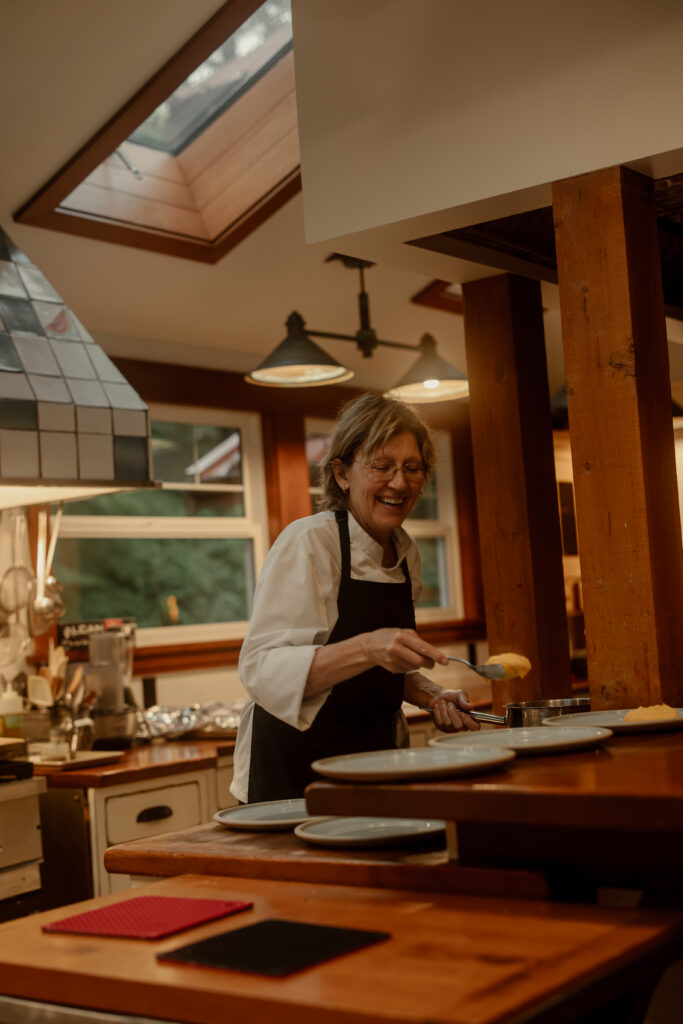
And she approaches lodge cooking differently than restaurant cooking. In a restaurant, she had once worked with large teams and complex plating systems. At the lodge it’s simply herself, and typically one assistant.
“Luckily, I’m a good organizer.”
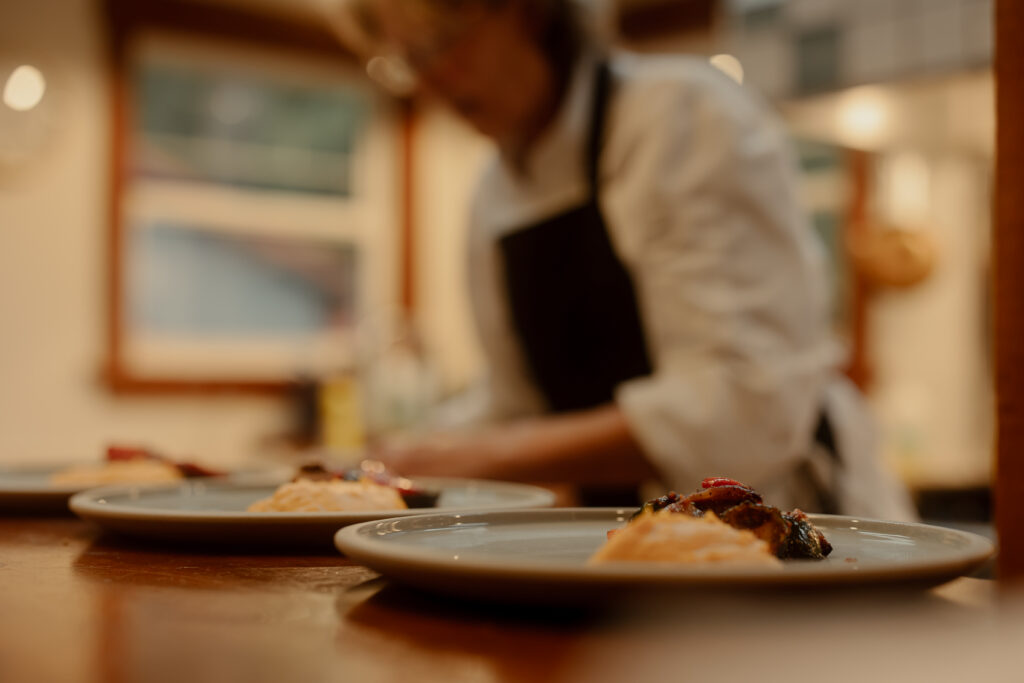
Experience allows her to prepare some components in advance, thinking carefully about how each dish will come together at the moment of service.
Her training in pastry and bread making remains one of her greatest joys. Whenever she can she makes sourdough bread, focaccia, pita, and even uses sourdough discard for pancakes.
“People really like the homemade bread,” she says simply.
Cooking as Environmental and Seasonal Practice
Here at the lodge, Jeanne’s cooking is deeply shaped by coastal British Columbia’s environment. She prioritizes local ingredients whenever possible, including produce from Vancouver Island and the Fraser Valley. Seafood, of course, plays a central role in the lodge menu.
Her approach is practical rather than ideological. Hospitality, for her, is about meeting guests where they are. Even dietary restrictions are treated as creative opportunities, rather than limitations.
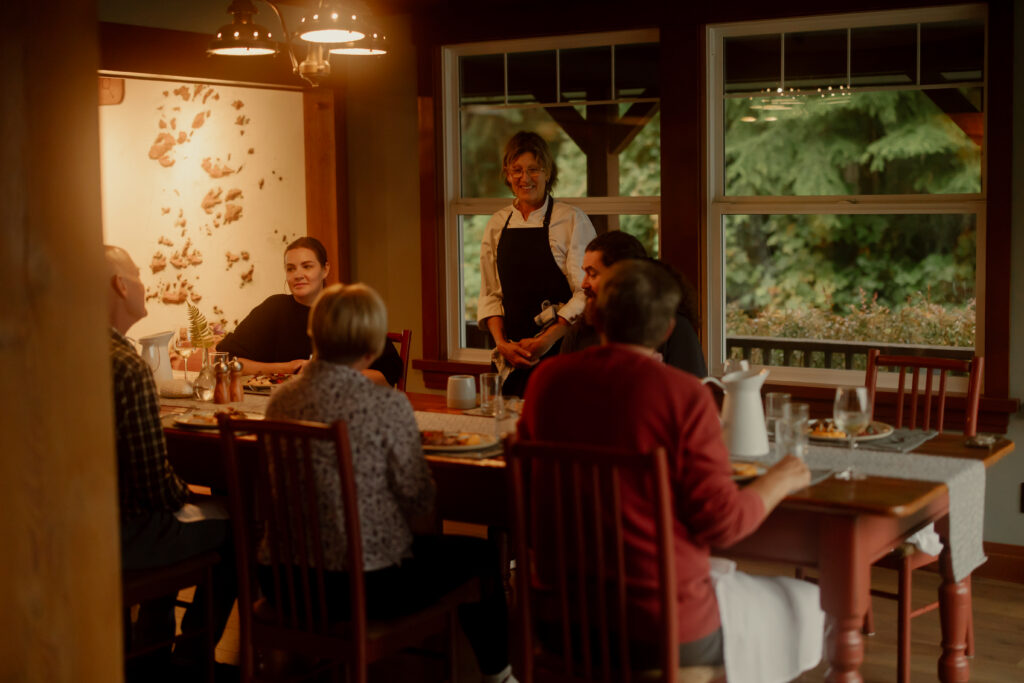
She also designs menus around guest activities and weather conditions. If guests spend the day on the water during a cool day, she prepares hearty soups and warm bread. If they spend hot afternoons on beaches, she creates light, composed salads and cooling dishes.
“You want to do your best to make it the best holiday of their life.”
The Rhythm of Gathering
Our dining room is central to Jeanne’s work. Guests arrive already emotionally open to the experience of coastal British Columbia. They have seen wildlife and felt the ocean wind. Jeanne ensures food becomes the final layer of that experience.
And she happily welcomes guests into the kitchen. She does not treat it as a restricted workspace.
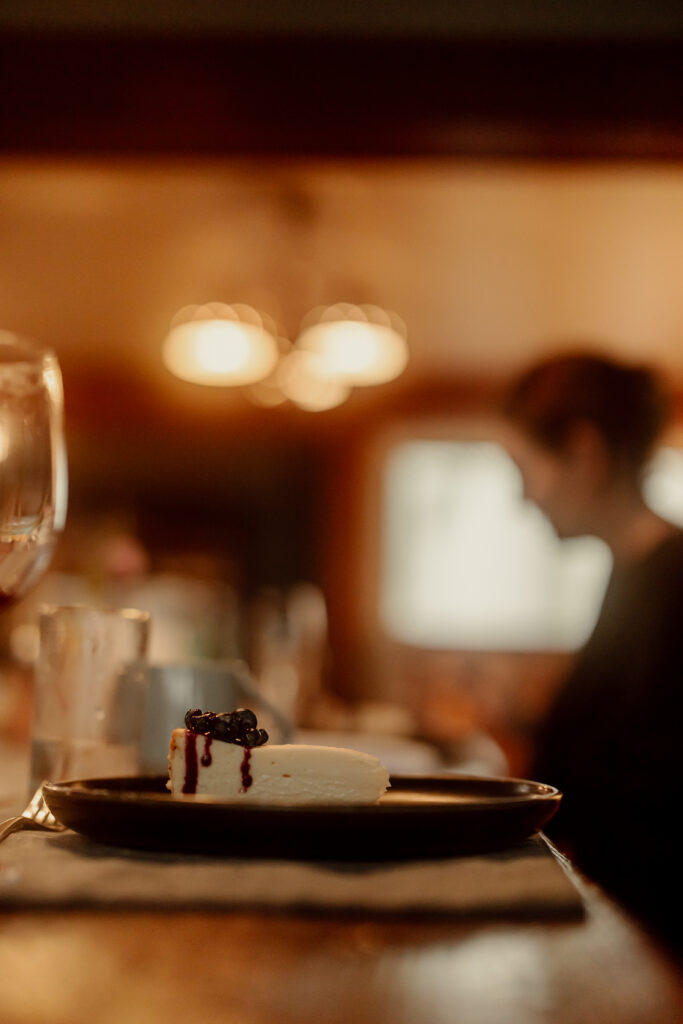
“Our guests come in and talk to me,” she says. “They like to look around and ask for recipes. And all that’s great because it’s giving them another memory to take home.”
She understands hospitality as memory-making. For her, cooking is not about being the centre of attention. It is about enhancing the experience of travel itself.
“I love being the enhancer,” she says. “If I can help create that atmosphere at the table and help them go away with those memories, that just makes my job so happy.”